

Tuesday, September 28, 2010


Monday, September 27, 2010

Keep your air fresh
A few years ago Kemal Meattle gave a compelling TED talk entitled "How to grow your own fresh air." To show that we can grow our own air, Mr. Meattle has conducted extensive studies in office buldings in India. His studies have shown that having enough of the right plants around can give ordinary slobs extraordinary powers (such as the power to stave off lung disease!).
For a government commussioned study, an office with 300 occupants was filled with 1200 plants. "... compared to other buildings in Delhi, the incidence of eye irritation reduced by 52%, lower respiratory symptoms by 34%, headaches by 24%, upper respiratory symptoms by 20%, lung impairment by 10-12% and Asthma by 9%. As a result of fewer sick days, employee productivity also increased."
Mr. Meattle mentions three plants in particular that are best in class:

For a government commussioned study, an office with 300 occupants was filled with 1200 plants. "... compared to other buildings in Delhi, the incidence of eye irritation reduced by 52%, lower respiratory symptoms by 34%, headaches by 24%, upper respiratory symptoms by 20%, lung impairment by 10-12% and Asthma by 9%. As a result of fewer sick days, employee productivity also increased."
Our experience points to an amazing increase in human productivity resulting from using these plants to be >20%, and energy costs to reduce by an extraordinary >15%.
Mr. Meattle mentions three plants in particular that are best in class:

The Money Plant is a filter like no other. It traps and stores airborne volatile organic compounds, like formaldehyde, while pumping out fresh clean O2. Live in a polluted area? Get yourself a few of these puppies.
The Areca Palm is a fantastic fresh air machine during the day. It is hearty, requires little water and is therefore very easy to take care of. Mr. Meattle suggests 4 per person; I have one.
The Mother-in-law's tongue (sharp!) is the night time expert. It is known to absorb 107 air pollutants including carbon monoxide and nitrogen monoxide. The mother-in-law can also eliminate bad odours, and it never tells you what to do!
The key property of the Mother-in-law's tongue comes from the fact that is that it is a CAM plant. Unlike normal C3 and C4 plants, CAM plants fix CO2 during the night. They store the necessary energy for photosynthesis during while light is available, and carry out the process in the dark. I promise you this; you'll both breath easier if you and your mother-in-law sleep in the same room together (sorry, had to).
Keep your air fresh!
Wednesday, September 22, 2010
Tim Besley is good, it's got some grit
Here is a nice paper by Tim Besley and Torston Persson called State Capacity, Conflict, and Development (ungated here). In their own words, it is a "first step towards disentangling some of the complex interactions between state capacity, conflict and development" from an academic economics perspective.
It is a nice little model that "shows why we might expect the [fiscal and legal components] of state capacity to be complements and hence develop together, and illustrates why a lower risk of external conflict, a higher degree of resource dependence, as well as lower political stability, weaken the incentive for state building."
More on this soon...
It is a nice little model that "shows why we might expect the [fiscal and legal components] of state capacity to be complements and hence develop together, and illustrates why a lower risk of external conflict, a higher degree of resource dependence, as well as lower political stability, weaken the incentive for state building."
Tuesday, September 21, 2010
Pic of the week - arabist.net

Algeria's Minister of Culture, Khalida Toumi, and Mrs. Ahmedinejad (and her entourage)
Sunday, September 19, 2010
Website of the week- ovguide.com / re1ease.net
If you are like me and increasingly use the internet for watching television, movies, clips and any other form of visual entertainment, you probably find yourself trying to keep up with the latest website that streams. Streaming sites seem to always get shut down. I suppose it might be illegal in some way... In any case you don't want to fill your precious hard drive space with that stuff do you?
re1ease.net is just the ticket. It links to streaming content seamlessly (usually) and has a sleek look to it. Websites like rea1ese are often riddled with broken links, pop-ups and links to pay sights; on re1ease nuisances like those are fewer and further between than almost ever before.


re1ease.net is just the ticket. It links to streaming content seamlessly (usually) and has a sleek look to it. Websites like rea1ese are often riddled with broken links, pop-ups and links to pay sights; on re1ease nuisances like those are fewer and further between than almost ever before.
A sight to help you keep track of the latest streaming sites is called Ovguide.com. It is absolutely essential for watching any media online. Usually Ovguide.com links you to all you need. But so far, it has missed re1ease.net and for that reason it must share the title of website of the week.
Thursday, September 16, 2010
What's wrong with this view of international trade?
It's taught in Econ 101 after all...

Here’s the detailed technology by which you grow cars in Iowa:
click.
"First you plant seeds, which are the raw material from which automobiles are constructed. You wait a few months until wheat appears. Then you harvest the wheat, load it onto ships, and sail the ships eastward into the Pacific Ocean. After a few months, the ships reappear with Toyotas on them."
Hints: externalities, transport costs, environmental costs, primary sector dependence, politics/power relations, exchange rates, terms of trade, technological adaptation ...
Wednesday, September 15, 2010

Tuesday, September 14, 2010
Cuban Siesta
The Cuban government is planning to lay off 500,000 employees in what will become the single biggest economic overhaul carried out by the Cuban government since 1959. (In my last post on Castro, in some vague sense, I called it!) The plan is to allow more businesses to be privately owned and for the private sector to then soak up the half a million fired. Hmmn.
Of course, the Cuban government has promised more private enterprize before. After the collapse of the Soviet Union, Cubans in the early ninties were allowed to open restaurants in their homes. After a first round of licenses were issued, no more were allowed. The private restaurants, often run in the living rooms of homes (think abuelita knitting in the corner), had to pay a fee every month. If one month was missed, the license was withheld and never reinstated. Needless to say, the number of licensed private restaurants has dwindled down to just a handful remaining today.

Other promises of private enterprise have been equally halfhearted. I highly doubt that Cuba can adapt to a system of regulation rather than control quick enough to shift half a million people from the public to the private sector. But, this movement is coming from the top.
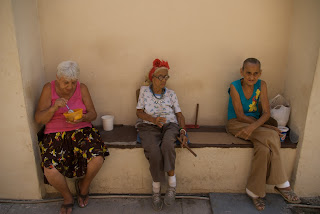
I travelled to Cuba last month with a friend and I saw first hand what the economy looks like on the streets of Havana. Raúl is right. Havanos don't seem to work too hard. As we walked through the narrow lanes of Havana Vieja, people were always ready to stop and chat. On two occassions men at work, or on their way, stopped to give us a tour of the local bars and attractions. The first tour lasted all day! What of the work they were meant to be doing? I learned quickly that it was worth it to take the day off work for the chance to swindle a tourist. At the end of each tour, one of which culminated in the kitchen of a small family home, we were pushed to buy fake cigars. Luckily I am somewhat of a cigar snob and noted them as fakes almost immediately. We politely turned them down on both occassions. Consequently, and lucky for us, the tours were free! The readiness and ease at which both gentlemen simply stopped work is surely indicative of the rigorousness of their jobs and perhaps the economy as a whole.

Although the buildings are crumbling, and many of the 50's franken-cars are limping along with their parts held together by jua-kali welders, no one seemed to be in dire straits. A cheery disposition was palpable as were brightly coloured buildings and tightly worn new clothes. According to the article "government has already cut some of the subsidies that many Cubans rely on to supplement their average monthly wage of about $20" This number is at odds with UN statistics which show yearly income per capita to be 5,500 USD in 2008.
I fear, given this latest plan, everyone's favourite socialist island paradise may see their admirable 1.6% unemployment rate suddenly spike!

Of course, the Cuban government has promised more private enterprize before. After the collapse of the Soviet Union, Cubans in the early ninties were allowed to open restaurants in their homes. After a first round of licenses were issued, no more were allowed. The private restaurants, often run in the living rooms of homes (think abuelita knitting in the corner), had to pay a fee every month. If one month was missed, the license was withheld and never reinstated. Needless to say, the number of licensed private restaurants has dwindled down to just a handful remaining today.

Music is everywhere in Havana Vieja
Other promises of private enterprise have been equally halfhearted. I highly doubt that Cuba can adapt to a system of regulation rather than control quick enough to shift half a million people from the public to the private sector. But, this movement is coming from the top.
“We have to erase forever the notion that Cuba is the only country in the world where one can live without working,”Raúl said last month. He claims that the state employs as many as one million excess employees. It is true that with fewer, poorer tourists coming to visit, Cubans can't afford to be lazy. But one million people suddenly unemployed, come on Castro, moderation is key!

Not lazy, just old

A cumbling old wall of patriots
Although the buildings are crumbling, and many of the 50's franken-cars are limping along with their parts held together by jua-kali welders, no one seemed to be in dire straits. A cheery disposition was palpable as were brightly coloured buildings and tightly worn new clothes. According to the article "government has already cut some of the subsidies that many Cubans rely on to supplement their average monthly wage of about $20" This number is at odds with UN statistics which show yearly income per capita to be 5,500 USD in 2008.
I fear, given this latest plan, everyone's favourite socialist island paradise may see their admirable 1.6% unemployment rate suddenly spike!

Subscribe to:
Posts (Atom)